 play_arrow
SoundVibe Radio
Adobe Is Bringing Hit Songs to Premiere Mobile — But There’s a Catch for Reels and TikTok
November 5, 2026 | SoundVibe Radio — Music & Technology
You spend an hour editing the perfect Reel. The cuts are on beat, the transitions feel right, and you’ve found exactly the song that makes the video work.
Then comes the question every creator eventually faces: can you actually publish it with that music?
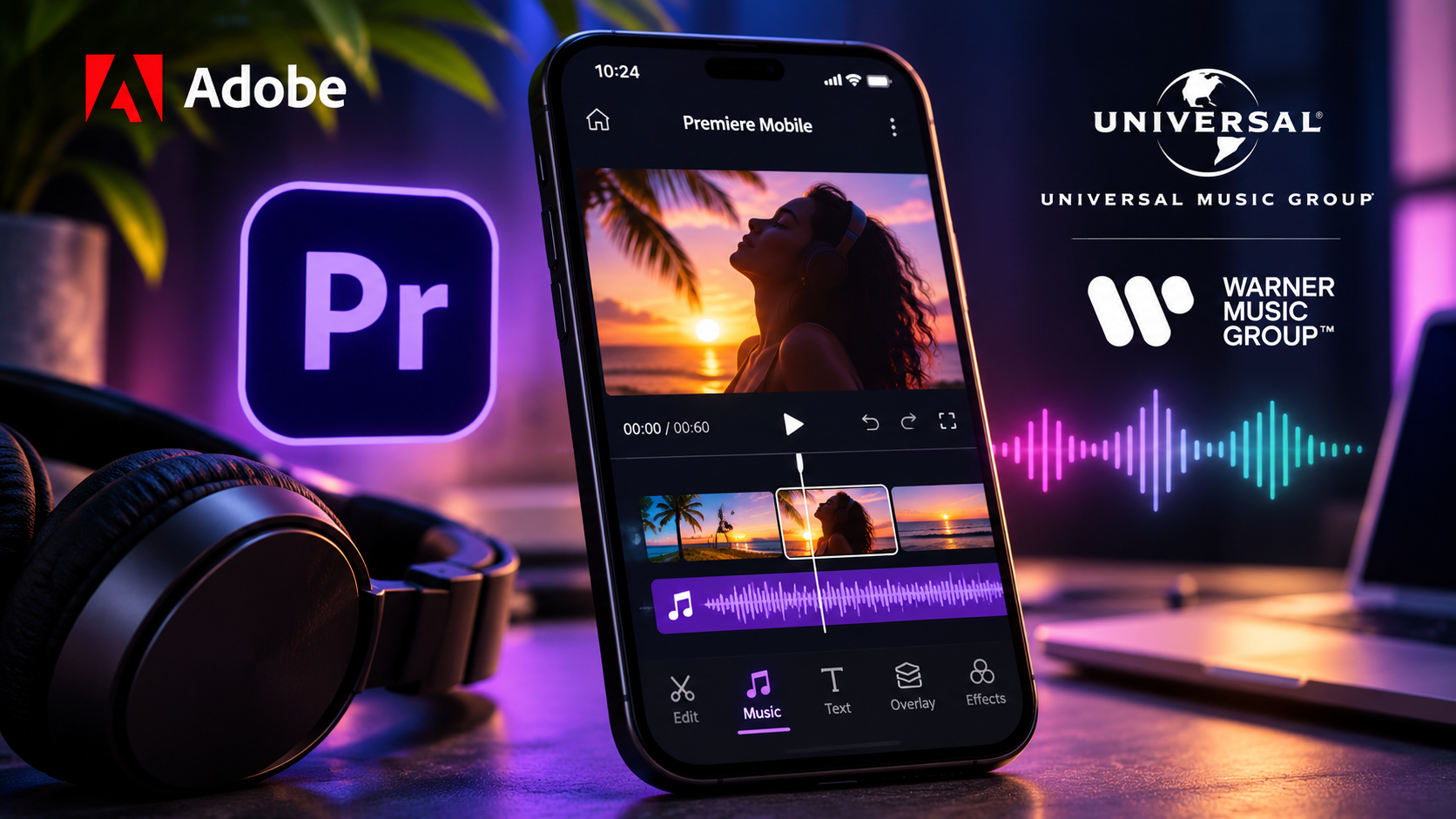
Adobe wants to make part of that process easier. On November 3, the company announced partnerships with Universal Music Group and Warner Music Group to bring clips from popular songs directly into Premiere Mobile, its free video-editing application.
It’s a significant move for an app competing for the attention of people making TikToks, Instagram Reels and YouTube Shorts. But before creators start celebrating the arrival of famous songs in their editing timelines, there’s an important detail in Adobe’s announcement: the new music is licensed for personal, non-commercial use. And the feature isn’t available yet.
Here’s what Adobe has actually announced, what remains unclear and why the difference matters.
What exactly is Adobe adding to Premiere Mobile?
Adobe says creators will soon be able to browse, preview and add music from the catalogues of Universal Music Group (UMG) and Warner Music Group (WMG) without leaving the Premiere Mobile editor.
The planned experience includes searching by artist or song title, filtering tracks by genre and duration, saving favourites and exploring collections selected by the labels.
Music-powered templates are also planned, allowing creators to start editing a video around a soundtrack rather than searching for music after the video is finished.
The partnerships bring two of the world’s most influential music companies into the mobile editing workflow. For creators who build videos around music, that changes where the creative process can begin.
Instead of editing a video, exporting it and then trying to find a suitable song on a social platform, users could build their edit around a licensed track from the beginning.
One important distinction: Adobe has announced the integration, but has not yet published the full list of available artists or songs.
Read Adobe’s official announcement.
The 60-second limit: what does it mean?
Adobe says users will be able to add up to 60 seconds of a popular song to a video. That makes the new feature particularly relevant to short-form content.
A 15-second fashion clip, a 30-second travel Reel or a minute-long personal montage could all be built around a recognizable piece of music, provided the track and intended use are covered by the service’s eventual terms.
However, a 60-second limit is not the same thing as a universal copyright exemption. It describes how much music Adobe intends to let users add through the feature.
It does not mean that any 60 seconds of any copyrighted song can be used anywhere, for any purpose, without restrictions. That difference becomes especially important when a personal video turns into an advertisement.
Can you use these songs on TikTok, Instagram Reels and YouTube Shorts?
Adobe says creators will be able to export finished videos and share them on supported, licensed social platforms.
Although TikTok, Instagram Reels and YouTube Shorts have been mentioned in industry reporting on the announcement, Adobe’s public blog post does not provide a complete, definitive list of covered platforms, account types and permitted uses.
That leaves several practical questions unanswered. Will every song have the same permitted destinations? Will commercial accounts face different restrictions? What happens if a video is later promoted as a paid advertisement? The November 3 announcement doesn’t settle those questions.
The safest conclusion is that Adobe is promising a simpler licensed-music workflow, not unrestricted permission to distribute commercial songs across the internet. Creators should check the specific usage terms when the feature launches, rather than assuming that exporting a video clears every possible use.
The biggest catch: personal use is not commercial use
This is arguably the most important part of the announcement. Adobe explicitly describes the forthcoming Universal and Warner music catalogue as licensed for personal, non-commercial use.
For someone sharing a personal holiday video, that may be exactly the kind of experience the new feature is intended to support. For a creator producing sponsored content, a company advertising a product, or a brand promoting its services, the situation is different.
Those projects can involve commercial music rights beyond the permissions provided for ordinary personal sharing. Consider three examples:
| Video project | What to consider |
|---|---|
| Personal travel Reel | Could fit the announced personal-use scope, subject to the final terms |
| Sponsored product video | Do not assume the new music licence covers it |
| Promotional video for a business or radio station | Separate commercial rights may be necessary |
Adobe directs creators who require commercially licensed music toward Adobe Stock Audio, which has a separate licensing framework. A song being available inside an editing application does not, by itself, establish that it can be used in every kind of published video.
Is Adobe Premiere Mobile free?
Yes. Premiere Mobile is available as a free video editor. Adobe offers the app on iPhone and Android, with features such as multi-track editing, audio enhancement, captions, templates and high-resolution exports.
The core editing tools are available without a subscription, while some generative AI features and additional services can require payment.
But there is one unresolved question: Adobe has not announced whether access to the new Universal and Warner music catalogue will involve additional fees or conditions. For now, it’s accurate to describe Premiere Mobile as free. It would be premature to promise that every newly licensed song will also be free to use.
When will the new music feature launch?
Adobe’s announcement says the integration is coming soon. As of November 5, 2026, the company has not confirmed an exact release date for the new licensed-music features.
It also hasn’t specified whether every new music function will arrive simultaneously on iPhone and Android.
Adobe MAX takes place from November 10–12, 2026, in Miami Beach and online, making it an upcoming event worth watching for product announcements. There is no confirmed promise, however, that Adobe will launch this particular music feature during the conference.
Until the company gives a precise date, any claimed launch schedule should be treated cautiously.
Why the partnerships matter beyond video editing
The Adobe announcement raises a bigger question about the relationship between music and short-form video.
For years, creators have often treated music as something to add near the end of a project. But some of the most memorable short videos are built in the opposite direction: the music comes first.
A particular drum pattern establishes the rhythm of the cuts. A vocal entrance creates the transition. A breakdown changes the atmosphere. The soundtrack gives the pictures their pace.
That workflow is especially familiar to DJs and electronic music creators, who regularly edit around drops, builds, transitions and percussion.
By bringing recognizable music into the editor itself, Adobe is moving the soundtrack closer to the beginning of the creative process.
For record labels, the appeal is also clear: a track used in a compelling video can reach audiences who might never have searched for the artist directly. For emerging producers, however, another question remains.
Will these integrations help listeners discover new artists, or will they make already-famous songs even more dominant in short-form video? Adobe has not published enough catalogue information to answer that question. It is one worth following.
What this means for independent artists and radio stations
For independent music communities, the development is relevant for two reasons. First, video is increasingly part of how people encounter music. A short clip might be someone’s first introduction to a producer, a DJ or a musical style.
Second, the rights attached to a track still matter. An independent radio station may have permission to stream music through its licensed broadcast service without necessarily having permission to use the same recording in a commercial social-media campaign. Those are different uses.
At SoundVibe Radio, where Afro House, Melodic House, Organic House and Deep House form the core of our programming, music discovery often starts with a track someone hasn’t heard before.
A music-led video can be a powerful introduction to that sound. But the best promotion respects both the artist’s work and the rights attached to the recording.
For radio stations, DJs and independent labels, Adobe’s forthcoming tools may create new creative opportunities — provided the commercial licensing rules are understood.
What we know — and what we’re still waiting to find out
Here is the current picture, based on Adobe’s November 3 announcement:
| Question | Answer as of November 5, 2026 | Are Universal and Warner involved? | Yes | Will Premiere Mobile include popular licensed songs? | Announced, coming soon | Maximum music clip length? | Up to 60 seconds | Is the feature available now? | Not yet | Is Premiere Mobile free? | Yes | Is the new music cleared for commercial advertising? | Not under the announced personal-use licence | Have supported social platforms been fully listed in the public announcement? | No | Has the full artist catalogue been announced? | No | Is there a confirmed release date? | No | Will the new catalogue cost extra? | Not announced |
|---|
For creators, those final unanswered questions are just as important as the headline announcement.
The SoundVibe perspective
Adobe’s partnership with Universal and Warner could make it much easier to build short videos around music people already recognize. That convenience is valuable.
But music discovery should still have room for the unexpected: an independent producer, a new label, a track heard for the first time during a late-night radio session.
The future of music-led content shouldn’t only be about faster access to familiar songs. It should also be about giving unfamiliar ones a chance to be heard.
Discover new music at SoundVibe Radio — broadcasting Afro House, Melodic House, Organic House and Deep House, 24/7.
The sound of good music.
Sources and editorial note
This article was researched on November 5, 2026. Details about the forthcoming integration are based on Adobe’s official announcement and statements from Universal Music Group. Features and licence terms may change before launch.
Featured post
Latest posts
Adobe Is Bringing Hit Songs to Premiere Mobile — But There’s a Catch for Reels and TikTok
Spotify Wrapped 2026: Release Date, Listening Cutoff & What Actually Counts

Afro House at ADE 2026: Black Coffee, Shimza, Nitefreak & Amsterdam’s New Sound

Best Afro House Radio for Studying and Productivity

NIBIRU Costinești 2026: stațiunea de entertainment și artiștii anunțați
Current show
Upcoming shows
Chart

 play_arrow
Se Fundieron (Radio Edit) Aaron Sevilla, Pomboklap & P.Rivas
 play_arrow
Habibi Timor Jana, AFRONOM & ASLN
 play_arrow
Şaşkın Erkin Koray





Post comments (0)